His Holiness the Dalai Lama has been the center of a controversy recently, an unfortunate linguistic misunderstanding. My good friend, Lama Lekshe, has written a beautiful and succinct explanation of the cultural meaning behind the phrase, che le sa, in her essay that will assuage anyone’s doubts about this great and compassionate human being. Her essay written April 13, 2023.
Lekshe, another three-year-retreat “graduate,” has decades of experience in Tibetan and Nepali culture. She’s also a wonderful teacher with a thriving sangha, Dekeling, in Portland.
Born in the wee hours of the morning, Wednesday, March 1, 2023 Midwife: Butter Lamp Press. Length: 302 pages Author and book are resting nicely, awaiting welcoming from friends and the wider community.
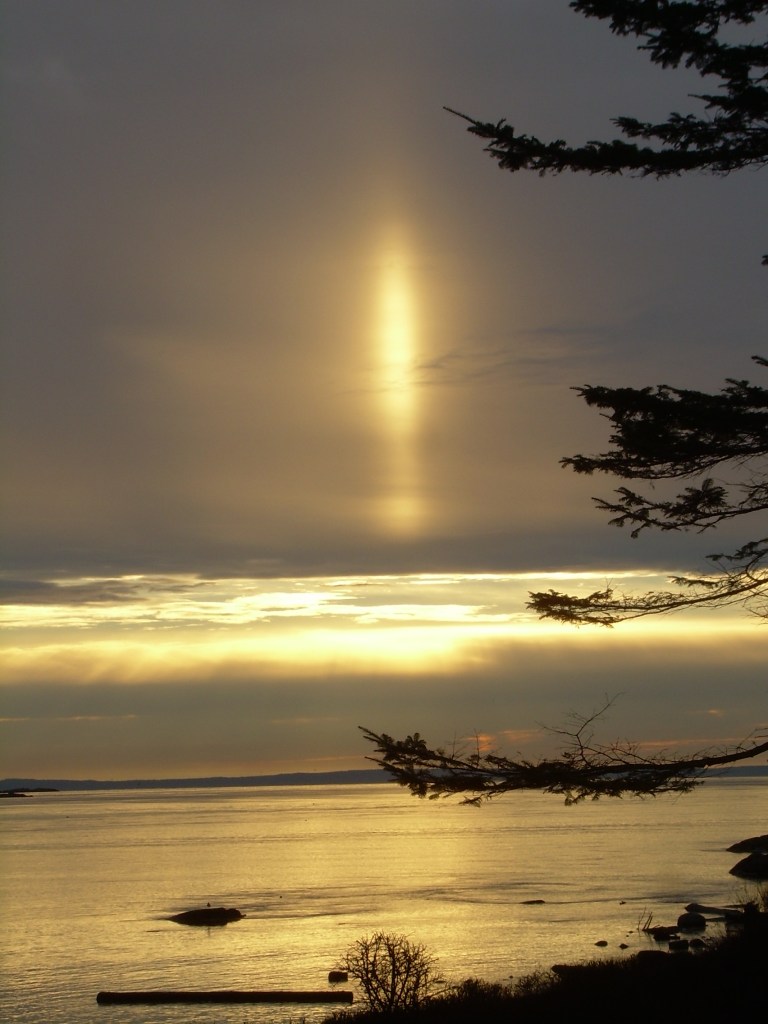
Sunrise on three-year retreat, sword of Manjushri Photo credit: Diane Berger
It’s been a long gestation: first the retreat itself which began in 2011; then a second, shorter retreat which ended in fall of 2016. At that point I began considering bringing a memoir out into the world, and later the work began in earnest. In those six years there were two when I didn’t work on it at all. And now, after concerted effort and with help from friends, ta da! it’s ready for reading.
In the world of book writing, I’ve been told it’s not such a long time, but I know many people have been waiting. So I thank you for your patience. The three-year retreat was truly a group effort, as some friends know firsthand, and so in some ways, this book is a thank you present. I hope very much that you find it worthwhile and engaging, even inspiring.
_____________________
The book can be purchased in two ways: through Amazon and bookstores. As much as Amazon is convenient, I’m hoping many will opt to request it at local bookstores. To encourage that, there’s a button on my new book website that takes the viewer to the book’s page on Indiebound where local bookstores are listed…which can then be clicked on or the shop phoned up. That’s my sincere plug for bookstores. As far as the life of the book is concerned, it’s difficult to say which will help it more, so it’s up to you.
_____________________
I hope you will also enjoy the new website, dedicated to the book: DianeRigdzinBerger.com. It has Endorsements, Excerpts, and Extras. The Extras page has some fun items, including a map and the original art for the book’s cover. Photos from retreat are sprinkled throughout the site. Endorsements come from Ken McLeod, Brian Hodel, and Lodro Rinzler. A review by Jude Rozhon shares that page, which was also published on NW Dharma’s blog.
_____________________
Word-of-mouth may be the best way to help along the life of this book. Here are some ways you can help:
Let your friends or community know about the book. Forwarding the book’s website is one suggestion. Another is social media.
After you’ve read the book, post a review on its Amazon page.
Also after reading it, you’re welcome to send me a comment which may appear on the book’s website.
_____________________
My wish for all of us is that our imaginations of what is possible expand in such a clear picture with such confidence, that the pathways open up, and we’re drawn in, without effort, like water mixing with water.
Mandala
means circle in Sanskrit. The flat drawings that we normally see are meant as
maps of the three-dimensional universe, or even multiverse, in Buddhist and
Hindu cosmology.
Mandalas
have arisen in the world’s spiritual traditions, from the calendars of the
Mayans to the Persian symbol of the sun, or the Celtic cross. In Christianity,
they appear in walkable labyrinths, or stained glass windows of ancient
cathedrals. Mandalas are found in nature: think of flowers, or the
cross-section of a tree trunk, a conch shell, the iris of an eye, or a
snowflake.
The
earliest Buddhist mandalas appeared in India around 200 CE, and spread to other
Asian countries, including Tibet. In Tibetan Buddhism the Mandala represents
the sacred essence of the universe, or the enlightened mind. It is an outward
manifestation of inner spiritual dimensions, using color, form and sacred geometry.
The Mandala is a tool through which philosophical and religious principles are
passed from teacher to student over generations.
The
Tibetan mandala is an exquisite form of ritual art. Every intricate detail
carries deep symbolic meaning. The form often appears as concentric circles
around a perfect square, representing a four-sided temple containing the
essence of the Buddha or other deities. Each deity has a corresponding mandala
constructed of specific shapes and colors. The Buddha of Compassion, Avalokiteshvara’s
mandala, for example, appears differently from one for Manjushri, Buddha of
Wisdom.
Medicine Buddha Sand Mandala, Bellingham, Washington, 2019
Each mandala detail represents precise parts of a palace, including cornices, columns, lintels, etc. The mandala is inhabited. At the center resides the main deity, and around the circular perimeter is a row of protector deities. The four sides have entranceways through which the deity is approached. The mandala is divided into four sections that correspond to the four directions, indicated by its characteristic color. The center makes a fifth direction. Blue in the east; yellow south; red west; green north; and white at the center. (Sometimes blue and white are switched.)
In contemplative
meditation, the Mandala can serve to focus and calm the mind. At other times, practitioners
may visualize the symbolic representation of the pure land of that deity, or
pure essence of the enlightened mind. This is meant to cultivate one’s inner
spiritual qualities and the potential to achieve an enlightened state.
Mandalas are created as offerings to bless and heal the world and all its inhabitants. They are also a profound teaching on impermanence—a central principle of Buddhist philosophy. Although some Mandala art is preserved in sacred paintings, practitioners create mandalas of sand and other materials that are then dissolved and returned to nature. From creation through dissolution, the Sand Mandala is a beautiful dance illustrating the impermanence of all things.
Thanks to Marcia Meyers for contributing to this piece, and to Brian Hodel for the title.Copies were handed out at the Kilung Foundation’s 2019 “Prayer for the Earth: Tibetan Sand Mandala Exhibit.”

 Awaken in the Present Moment